

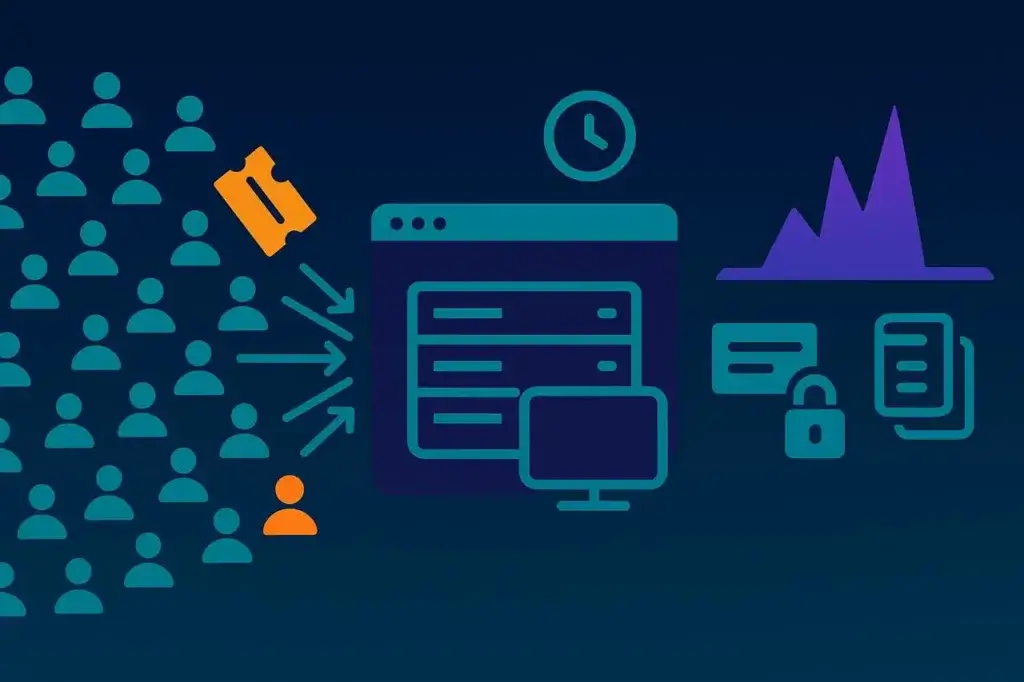
Nobody likes a ticketing crash at 9 AM. Yet it happens often enough: concert tickets disappear, airline sites stall, checkout screens freeze, and users flood social media with complaints. Behind many failed ticket drops, booking surges, and flash sales is the same problem: a system that was not prepared for high concurrency.
High concurrency load testing simulates large numbers of users performing actions at the same time, not just over time. It measures how applications behave when simultaneous requests pile up, such as when everyone hits “Buy Now” in the same second. For ticketing, booking, registration, and flash-sale systems, that is not a theoretical problem. It is the moment that determines whether the platform holds up or fails publicly.
In this article, we’ll explore why concurrency breaks even mature platforms, which scenarios demand this type of testing, how to design meaningful tests, and how tools like LoadView help simulate launch-day traffic more realistically.
Why High Concurrency Breaks Applications
Most load tests focus on throughput, or how many requests per second an application can process. Concurrency testing is about something different: what happens when many sessions overlap. When multiple users compete for shared resources at once, weaknesses appear that normal load tests may miss.
Typical breaking points include:
- Database Contention: Simultaneous transactions can lock rows or tables, causing slowdowns and deadlocks.
- Queue Backpressure: Message queues, order systems, or payment gateways can backlog when consumers cannot drain requests fast enough.
- Session Store Exhaustion: In-memory caches like Redis or Memcached may run out of connections or memory under spike loads.
- API Rate Limits: Third-party services can throttle bursts, cascading into failed requests.
- Thread Pool Saturation: Application servers may hit max threads and begin queuing requests, increasing latency quickly.
- Inventory or State Conflicts: Ticketing, booking, and ecommerce systems can fail when many users try to reserve or purchase the same limited item at once.
Concurrency failures are rarely linear. Systems often appear stable until one invisible threshold tips everything over. Latency can jump from 300 ms to 3 seconds and then to complete timeouts. That cliff effect is exactly what high concurrency load testing exposes: how your system behaves when everyone shows up at once.
Common Scenarios That Demand High Concurrency Testing
Not every system faces concurrency as an occasional risk. Some industries live with it as a daily reality. These platforms are built on scarcity, time sensitivity, or synchronized demand. When a sale or release hits, they do not get a gradual traffic ramp. They get a wall of users arriving at once. In these situations, performance is often binary: the platform either stays available or becomes the story for the wrong reason.
1) Ticketing Platforms
Few environments punish concurrency failures like ticketing. For a major concert or sports event, tens of thousands of fans may be ready to click “buy” the instant tickets go live. Those clicks trigger simultaneous inventory locks, payment authorizations, and confirmation calls across multiple services. If any step stalls, the entire flow backs up. The result can include duplicated holds, frozen carts, failed payments, and user frustration that spreads quickly.
2) Booking Systems
Airlines, hotels, and travel aggregators experience similar concurrency surges, but with added complexity: dynamic pricing and real-time inventory. When a fare drop or holiday deal is announced, thousands of users search and select at once, each triggering downstream APIs, cache lookups, pricing feeds, and availability checks. Under concurrency, these systems need to stay online and consistent, ensuring every user sees accurate availability and pricing.
3) Flash Sales and Product Drops
Ecommerce brands, game publishers, and limited-edition retailers often compress demand into a short window by design. A flash sale or product drop can create instantaneous traffic across product pages, carts, inventory services, payment gateways, and order confirmation workflows. The biggest challenge is not just total volume. It is concurrency density, or how many users are trying to complete the same critical action at the same moment.
4) Public-Sector Portals
Government and education systems often face concurrency from predictable deadlines rather than marketing hype. Registration windows, grant applications, tax deadlines, permit renewals, and enrollment periods can generate synchronized demand. These systems may also be constrained by legacy infrastructure and strict uptime requirements, making concurrency testing essential for avoiding service disruptions.
High concurrency testing exists for these exact moments when systems are pushed by schedule, marketing, scarcity, or policy. These are the scenarios where failure carries a real cost: lost revenue, broken trust, operational disruption, and public embarrassment. Testing here is not about curiosity. It is about knowing whether your platform can handle the crowd before the crowd arrives.
Designing and Running High Concurrency Tests
The value of concurrency testing lies in realism. It is not about blasting a system with traffic. It is about shaping that traffic to mirror how real people behave when urgency peaks. A thousand virtual users spread evenly over an hour tells you one thing. A thousand users hitting “submit” within thirty seconds tells you something very different.
The first step is to model how users actually arrive. High-concurrency events rarely build gradually. They spike. Using sharp ramp, burst, or step profiles exposes weaknesses that steady-state load tests may never reveal. Bottlenecks appear when the system is asked to go from idle to full throttle almost instantly, not when it slowly coasts up to speed.
Next, focus on user journeys, not isolated endpoints. Each virtual user should execute complete workflows, such as logging in, selecting seats or inventory, proceeding to checkout, and confirming the transaction. Browser-based testing, like what LoadView supports, captures real front-end dynamics including JavaScript execution, render delays, and client-side timeouts that protocol-only tools may miss.
Geographic distribution matters too. Ticketing, booking, and launch events may concentrate in specific regions or time zones. Simulating traffic from those same areas gives a more accurate picture of CDN performance, DNS resolution, regional latency, and network conditions under pressure.
Concurrency testing also requires precision in how you handle variables. Adjusting the mix of transactions, ramp rates, think times, user roles, and test data changes how state collisions occur. The goal is not raw user count. It is recreating simultaneous operations that fight for the same resources.
Finally, no test is complete without visibility. Pair synthetic traffic with backend telemetry such as APM traces, database metrics, queue depth, cache hit rates, connection pools, and system logs. Only by correlating what users experience with what the system is doing underneath can you translate test data into action.
A good concurrency test is defined by timing, not just scale. It is not only about how much load you generate. It is about when it hits and how faithfully it mirrors real-world urgency.
Test Metrics and What They Mean
Measuring success under concurrency requires more nuance than average response time. Key indicators include:
- Concurrent Sessions: The number of active users performing operations simultaneously.
- Throughput: The sustained request or transaction rate the system maintains before saturation.
- Latency Percentiles: p95 and p99 response times matter more than averages because they reveal the slowest user experiences.
- Error Rate: Failed or timed-out requests under load indicate saturation points.
- Transaction Completion Rate: The percentage of users who successfully finish critical flows such as checkout, booking, registration, or purchase confirmation.
- Queue Depth and Lock Wait Time: Backend contention metrics that reveal the cause behind slow pages or failed transactions.
- System Resource Utilization: CPU, memory, network, cache, database, and connection pool usage that define true capacity ceilings.
Interpretation is where the value lies. Flat latency with climbing throughput is healthy. Rising latency with constant throughput signals saturation. Spiking errors, queue depth, lock waits, or abandoned transactions mark the collapse point. The goal is not perfection. It is identifying the safe operating zone before the system crosses into failure.
Engineering for High Concurrency
Running high concurrency tests is only half the battle. The real value comes from what you do before and after the test. When thousands of users hit your platform at the same instant, every layer matters, from connection pools and caches to payment integrations and database locking behavior.
To prepare for realistic concurrency, focus on the fundamentals that govern stability under pressure:
- Scale Connection Pools and Threads: Match peak concurrency, not average usage.
- Implement Caching Strategically: Cache static assets, session data, inventory views, pricing data, and other safe-to-cache resources to reduce database pressure.
- Enable Autoscaling Policies Early: Configure autoscaling to absorb bursts before saturation, not after users are already timing out.
- Tune Database Isolation Levels: Minimize unnecessary locking while preserving transactional consistency.
- Use Asynchronous Queues: Move non-critical or delayed workflows into queues so background tasks do not block synchronous user actions.
- Implement Circuit Breakers and Rate Limiting: Protect dependent services from cascading failures.
- Design for Graceful Degradation: A controlled slowdown, waiting room, queue, or reduced feature set is far better than a full crash.
- Protect Critical Flows: Prioritize checkout, booking confirmation, payment authorization, and account access over lower-priority background work.
High concurrency engineering is not about building for infinite scale. It is about controlling failure modes. A resilient system does not promise that nothing will ever slow down. It ensures that when a surge comes, the system degrades predictably, protects critical workflows, and recovers quickly.
Case Example #1: Simulating a Ticket Drop
Consider a national concert tour where tickets open at 9 AM. The business team expects 50,000 users in the first five minutes. The test objective is to confirm that the platform can sustain 10,000 concurrent purchase attempts without major degradation.
Setup:
- Browser-based test scripted with LoadView’s EveryStep Recorder to replicate a full seat selection and checkout process.
- Load ramp from 0 to 10,000 users in 120 seconds, then hold for 5 minutes.
- Distributed load across relevant US regions.
- Backend monitoring for database locks, queue depth, payment response times, and checkout errors.
Observation:
At 7,000 concurrent users, latency averaged 450 ms. At 8,500, queue wait times spiked, and 3% of checkouts timed out. Database logs revealed row locking on seat reservations.
Action:
Developers refactored the reservation logic to use optimistic locking and cached seat maps. Retesting showed stable performance at 12,000 concurrent users with sub-500 ms response times.
The lesson: concurrency failures are reproducible. Proper load testing turns “it crashed” into “it failed at 8,500 users for this reason,” giving teams actionable insight.
Case Example #2: Handling a Booking Surge
Imagine a travel booking platform launching a flash promotion with discounted fares released at noon across multiple airlines. Within seconds, tens of thousands of users rush in to search flights, compare prices, and complete reservations. Unlike some ticketing systems where the main bottleneck is checkout, booking platforms can face concurrency pressure across search, inventory, pricing, and payment layers at the same time.
Setup:
- Objective: Validate the site’s ability to handle 5,000 concurrent flight searches and 2,000 overlapping bookings.
- Scenario: Scripted with LoadView to replicate realistic user behavior: login, destination search, fare filter, selection, and confirmation.
- Load Pattern: Ramp to 7,000 concurrent sessions over 3 minutes and sustain for 10 minutes.
- Monitored Metrics: API latency, cache hit rate, database lock times, external airline pricing feeds, and payment response times.
Observation:
Performance held steady during search but collapsed during fare selection. Cache hit rate dropped from 92% to 60% as concurrent users requested overlapping routes with variable parameters. The booking service began queueing at 1,500 active transactions, producing intermittent timeouts.
Action:
Engineering implemented two fixes:
- Query Normalization and Parameter Caching: Standardizing API requests reduced redundant lookups and restored cache efficiency.
- Asynchronous Booking Confirmation: Converting the final reservation step to a queued workflow reduced synchronous blocking during payment authorization.
Result:
A retest achieved smooth performance with 9,000 concurrent users. Search latency stabilized under 800 ms, and checkout completion rose from 87% to 99%.
This scenario shows how booking systems can fail not from raw user count alone, but from overlapping dynamic queries and synchronous dependencies. High concurrency testing surfaces those weak points early, giving teams room to re-engineer before a promotion or peak travel season exposes them in production.
High Concurrency Load Testing and LoadView’s Role
High concurrency is not a one-time event. Traffic patterns evolve, new features introduce latency, and scaling policies drift. The solution is continuous readiness: running controlled concurrency tests as part of release cycles and pre-launch checklists.
LoadView helps make this operationally feasible. Its managed cloud platform can generate distributed load, execute real browser sessions, and simulate realistic clickstreams without local setup. Teams can schedule recurring tests, review reports, and use the results alongside backend monitoring to identify bottlenecks.
Where protocol-only tools often test APIs in isolation, LoadView can measure what users experience under simultaneous load. That difference helps teams connect synthetic test data to real business outcomes.
Regular high concurrency testing ensures you do not discover weaknesses on launch day. Whether it’s a ticket release, travel booking promotion, public registration window, or flash sale, you can identify your system’s breaking point before users do.
Wrapping It All Up: Final Thoughts on High Concurrency Load Testing
High concurrency events do not forgive weak architecture. They expose unoptimized queries, shared resource limits, missing indexes, fragile APIs, and overloaded payment or inventory systems. The result can be downtime, failed transactions, and public frustration.
With deliberate high concurrency load testing, those outcomes become more predictable and preventable. The key is not just generating traffic. It is simulating reality: simultaneous clicks, overlapping transactions, shared inventory conflicts, and instantaneous demand.
Organizations that test this way move from reacting to outages to anticipating them. They understand their thresholds, tune capacity accordingly, and enter launch day with data instead of hope.
LoadView helps make that confidence tangible by simulating realistic browser-based traffic and distributed load so teams can see how systems behave under pressure before the crowd arrives. In ticketing, booking, ecommerce, and any surge-driven business, performance is not just a metric. It is reputation, revenue, and trust.