

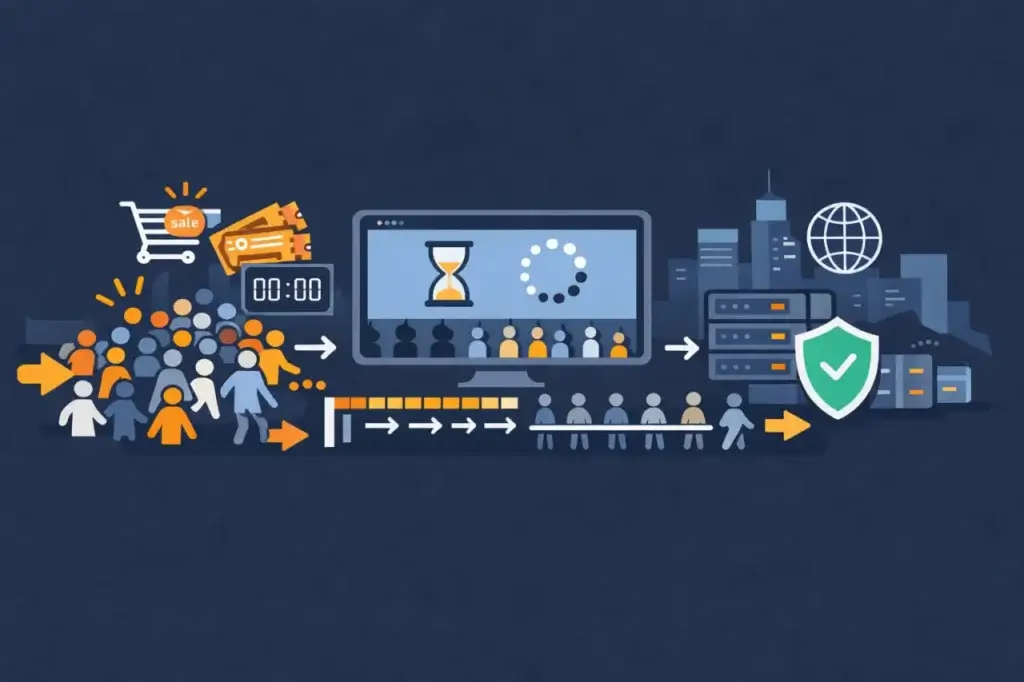
Most systems are built to serve users as quickly as possible. Virtual waiting rooms are built to do the opposite. Their purpose is not speed, throughput, or even availability in the traditional sense. Their purpose is control. They exist to slow users down, hold them in place, and admit them gradually so downstream systems don’t collapse under pressure.
That inversion breaks a lot of assumptions teams carry into load testing. Metrics that make sense for APIs or web applications—response time, error rate, requests per second—tell you very little about whether a waiting room will behave correctly when it matters most. A queue that returns fast responses while silently losing state, violating order, or admitting users unpredictably is not healthy. It is unstable.
Extreme demand is not an edge case for waiting rooms. It is the operating condition they are designed for. Load testing them as if they were normal web properties creates false confidence, because the most important failure modes are not performance problems at all. They are control problems that only surface under pressure.
The Role of Virtual Waiting Rooms in Modern Traffic Control
Virtual waiting rooms sit at a critical boundary in modern architectures. They are not optimization layers. They are safety valves.
When traffic spikes beyond what backend systems can safely handle—during flash sales, ticket drops, product launches, regulatory deadlines, or viral events—waiting rooms absorb the surge. They prevent uncontrolled fan-in, preserve system stability, and give operators a lever to regulate admission without taking the entire experience offline.
At a functional level, a waiting room is responsible for a few core behaviors:
- It must identify excess demand quickly and consistently.
- It must hold users in a controlled state without losing their place.
- It must release users at a predictable, adjustable rate.
- It must do all of this without amplifying load on the very systems it is protecting.
Whether implemented via a CDN feature, a third-party provider, or a custom admission service, the role is the same. The waiting room becomes part of your availability architecture. If it fails, users do not experience slowness. They experience disorder—random access, broken flows, or total lockout.
That makes correctness more important than raw performance. And correctness is much harder to validate with traditional load testing patterns.
What Extreme Demand Looks Like in Practice
Extreme demand is often misunderstood as “lots of users at once.” In reality, the defining characteristic is not concurrency. It is arrival rate.
Flash traffic rarely ramps smoothly. It arrives in bursts: thousands of users refreshing at the same second, retrying aggressively, opening multiple tabs, switching devices, or returning repeatedly when they believe admission is imminent. The pressure is front-loaded and chaotic, not evenly distributed.
This matters because waiting rooms are most vulnerable during transitions. The first spike when the event opens. The release waves as users are admitted in batches. The recovery period when demand finally subsides. These are the moments when state is created, updated, expired, and reconciled at scale.
A system that looks stable under sustained concurrency can still fail catastrophically when faced with a sudden arrival surge. Queue position assignments drift. Tokens expire too aggressively. Admission pacing slips. Clients hammer retry endpoints harder than expected.
Load testing that focuses on steady-state behavior misses where the real risk lives.
Success Criteria Change Under Queue-Based Control
Traditional load testing rewards systems for being fast and permissive. Waiting rooms succeed by being slow and restrictive—deliberately.
Under extreme demand, high rejection rates are not a failure signal. They are expected. Long waits are not performance regressions. They are the product. What matters is whether the system behaves consistently and honestly while denying access to most users.
This forces a different definition of success.
- A healthy waiting room does not admit users quickly. It admits them predictably.
- It does not minimize latency. It preserves order.
- It does not eliminate errors. It fails gracefully and transparently.
From a testing perspective, this breaks common heuristics. HTTP 200 responses say nothing about whether a user’s place is preserved. Low response times do not reveal whether fairness is maintained. Even backend survival is insufficient if users perceive the experience as random or broken.
The most dangerous failures in waiting rooms are silent. Users may see a page load, a spinner spin, and a countdown advance—until suddenly it resets or never resolves. Traditional metrics remain green while trust evaporates.
Load testing must be able to detect these failures before users do.
Failure Patterns Unique to Virtual Waiting Rooms
Waiting rooms don’t usually fail with obvious outages. They fail by losing control.
One common failure is queue state loss. Under pressure, systems restart, caches evict entries, or replication lags. Users who were waiting for minutes suddenly rejoin at the back—or worse, are released out of order. The system appears responsive, but fairness is broken.
Token expiration is another subtle risk. Queue tokens, cookies, or local storage entries may be configured conservatively to limit abuse. Under real-world wait times, those expirations can trigger mass resets. Users refresh endlessly, creating more load while making no progress.
Admission rate drift is harder to spot. A waiting room may be configured to release users at a fixed rate, but under sustained pressure the actual release cadence slips. Small deviations compound, leading to unpredictable waves of access that stress backend systems precisely when they were meant to be protected.
Geographic inconsistency introduces further complexity. Distributed waiting rooms may behave differently across regions, admitting users in one location faster than another or losing state asymmetrically. These issues rarely appear in single-region tests.
Finally, client behavior itself becomes a failure amplifier. Auto-refresh logic, retry loops, and JavaScript polling can multiply load dramatically when users believe progress is stalled. A waiting room that mishandles client signaling can unintentionally trigger its own denial-of-service condition.
These are not edge cases. They are the dominant failure modes under extreme demand.
What Waiting Room Load Tests Must Validate
Because the risks are behavioral, waiting room load tests must validate behavior, not just capacity.
The core questions are simple, even if answering them is not:
- Does the system preserve user state over time?
- Is admission paced consistently under pressure?
- Are users released in the order they entered?
- Does rejection remain graceful and informative?
- Do backend systems remain insulated throughout the event?
Metrics exist to support these questions, but they are secondary. Admission rate stability matters more than raw throughput. Queue persistence matters more than response time. Error handling behavior matters more than HTTP status codes.
Effective load tests treat the waiting room as a control loop. They observe how it reacts to spikes, how it stabilizes, and how it recovers. The goal is not to push until something breaks, but to verify that nothing breaks silently.
Designing Load Tests for Queue-Controlled Traffic
Designing meaningful tests for waiting rooms starts with modeling arrivals realistically. Smooth ramps are rarely appropriate. Tests should simulate sudden spikes, overlapping waves, and prolonged overload conditions where most users remain queued for extended periods.
Duration matters as much as intensity. Waiting room failures often appear after ten, twenty, or thirty minutes—once tokens expire, caches churn, or internal counters drift. Short tests miss these dynamics entirely.
Release behavior must also be exercised deliberately. Coordinated admission waves should be triggered to validate that backend systems remain protected while users experience progress. Tests should observe not just how many users are admitted, but how evenly and predictably that admission occurs.
Geographic distribution should not be an afterthought. Real demand is global, and queues frequently sit at the edge. Load tests must reflect that distribution to surface regional inconsistencies. Many teams now also combine waiting room load tests with real-time observability tools to monitor infrastructure metrics, queue state, and admission patterns during simulations, helping identify subtle control issues before real traffic events occur.
Above all, waiting room tests must be observational. They should track individual user journeys through the queue, not just aggregate metrics. Without that visibility, the most important failures remain invisible.
Why Real Browsers Are Required for Waiting Room Validation
Most waiting rooms live on the client.
Queue position updates, redirects, polling intervals, token storage, refresh logic—these behaviors are implemented in JavaScript and executed in real browsers. Protocol-level tools cannot see them, let alone validate them accurately.
A synthetic request that receives a valid response does not experience waiting. A browser does. It executes scripts, stores tokens, refreshes state, and reacts to timers. It behaves like a user.
Real-browser load testing exposes behaviors that otherwise go untested: excessive polling, broken redirects, expired cookies, client-side crashes, and retry storms triggered by UI logic. These are precisely the behaviors that dominate real events.
If the goal is to understand how a waiting room behaves for users under extreme demand, browsers are not optional. They are the test surface.
Operational Timing: When Waiting Rooms Should Be Tested
Waiting room testing is most valuable before it is needed.
Tests should run ahead of major launches, marketing campaigns, ticket releases, and public deadlines. They should also follow configuration changes, provider updates, or infrastructure shifts that affect admission logic.
For organizations that rely on always-on waiting rooms, periodic validation is essential. Extreme demand does not announce itself politely. When it arrives, the waiting room must already be proven.
Testing is not about certification. It is rehearsal.
Conclusion: Control Systems Fail Quietly Until They Don’t
Virtual waiting rooms are built to absorb failure so the rest of the system does not have to. When they work, users wait patiently, systems stay online, and events succeed. When they fail, the failure is immediate, public, and difficult to recover from.
Load testing is the only practical way to see how these systems behave under the conditions they were designed for. But only if the tests are designed for control, not capacity. Only if they observe behavior, not just metrics. Only if they reflect real user interactions, not abstract request flows.
Extreme demand is predictable. Waiting room failures are not inevitable.
With real-browser load testing, teams can validate that their waiting rooms behave honestly and consistently under pressure—before extreme demand turns hidden weaknesses into visible incidents.